Coached barbell and dumbbell training for people in their 50s, 60s, and 70s — built around replaced joints, cranky knees, low bone density, and whatever your doctor has told you. Below: exactly what your first session looks like, two real workouts, and how we handle specific conditions.
Your first hour, honestly
Most people over 50 don't call a gym because they aren't sure they want to train. They don't call because they don't know what they're walking into. So here it is, in order.
You'll sit down with Stan for about fifteen minutes, before you touch anything. He'll ask what your doctor has said, what surgeries you've had, what hurts and when, what medications matter, and what you actually want to be able to do — carry a grandchild, get a kayak off the roof rack, get up off the floor without a hand. That conversation is the most important part of the hour, and it's the part most gyms skip.
Then we look at how you move. You'll walk. You'll stand up out of a chair a few times. We'll see what your shoulders do overhead, whether you can hinge at the hips without rounding your back, how your ankles and hips behave in a squat, and how long you can stand on one leg. Nothing is timed, nothing is scored, and nobody is watching but your coach.
After that you'll lift something — but nothing heavy. Usually an empty barbell or a light kettlebell, a few sets of five or six reps, so you get the feel of a hinge and a squat under a little load and Stan gets to see how you organize yourself when there's weight in your hands. If something hurts, we stop and swap it, then and there.
You'll be here about an hour. You won't lift anything near a maximum, and you should not be sore the next day. If you are, we made the first day too hard, and we'll say so. At the end you'll get a plain-language plan: how many days a week, which movements we're starting with, which ones we're leaving alone for now, and what we want to see change in eight weeks.
The first session is free, and there's no obligation attached to it.
The evidence
This is the one part of the page where we're going to sound clinical, because the numbers are the argument.
Adults lose roughly 3–8% of their muscle mass per decade after age 30, and the rate accelerates after 60. That loss — sarcopenia — is the mechanism behind most of what people write off as "just getting older": the stairs getting harder, the grocery bags getting heavier, the recovery from a stumble getting slower.
Resistance training is the only intervention that directly reverses it, and the evidence is strongest in exactly the population that's most often told to be careful. In a landmark trial, frail nursing-home residents with an average age of 87 gained significant strength and walking speed from progressive resistance training over ten weeks. In a separate study, men and women in their nineties more than doubled their leg strength in eight weeks of high-intensity training.
Bone responds too, and it responds to load rather than to caution. The LIFTMOR trial randomised 101 postmenopausal women with low bone mass — osteopenia and osteoporosis both — to eight months of twice-weekly supervised high-intensity resistance and impact training, five sets of five above 85% of a one-rep max on deadlift, overhead press and squat. Bone mineral density improved at the lumbar spine and femoral neck against a low-intensity home-exercise control, along with every measure of physical function, and across the whole trial there was a single adverse event: one minor back spasm. Two caveats we'd rather state than have a clinician point out — the participants were otherwise healthy and screened for conditions and medications affecting bone, and every session was closely supervised. That second caveat is the entire argument for coaching rather than a printout.
Falls are the other half of it. Falls are the leading cause of injury-related death among adults 65 and older in the United States, and the two things that most reduce fall risk are lower-body strength and balance — both trainable, both at the front of every session we run.
Workout examples
Two workouts, so you can see both ends of it: what week one actually looks like, and what a session looks like once you've been at it a few months. Every number below gets set around you.
No barbell on the floor, no conditioning finisher, nothing that leaves you sore. Week one is about learning to hinge, learning to brace, and getting up and down off a box under control. Most people are surprised how easy it feels.
Balance goes first, while you're fresh. It's the piece almost everyone skips and the one that protects you most.
This is where most people are by month three or four. Same four pieces, more load, and a short conditioning block on the end. Loads, range of motion, and pace are all still set around you.
One short task at the top of each minute, four times through — twelve minutes total. Low impact, nothing jarring, and no jumping:
The built-in rest is the point. You should finish each task with fifteen or twenty seconds to spare, breathing hard but able to talk. If a minute runs long, we cut the reps — the clock never wins.
Two sessions a week like this is enough to hold onto muscle, bone, and balance. Three is better if your schedule allows it.
Specific bodies
This is the part nobody writes down. If you have one of these, here is the actual constraint we work to and the actual substitution we make — so you know before you call, and so your physical therapist or physician can see exactly what we do.
These are two different levels of risk, and we don't treat them as one category.
The flexion restriction traces to Sinaki & Mikkelsen, Arch Phys Med Rehabil 1984 — postmenopausal women prescribed flexion exercises went on to have far more new vertebral fractures than those given extension work. The load side of it comes from LIFTMOR.
The first thing we ask is which surgical approach your surgeon used, because the at-risk position is not the same for an anterior and a posterior hip — and a growing number of surgeons now prescribe no positional precautions at all past the early weeks. If you don't know which you had, we'll ask you to check with the surgeon's office, and we default to the conservative set until you do.
On the "no precautions" point: Crompton, Osagie-Clouard & Patel, Acta Orthop 2020 pooled 6,900 posterior-approach hips and found no difference in dislocation rate between restricted and unrestricted protocols. We still follow your surgeon rather than the literature — but we know why some surgeons no longer restrict.
Range of motion sets the depth, and pain sets the load. Not the other way round.
Fusion, discectomy, laminectomy — the common thread is that we protect the segment and load everything around it.
Overhead is a privilege, not a requirement. Plenty of strong people never press straight overhead again and lose nothing that matters.
A note on words: we've stopped saying "impingement". The field has largely moved to subacromial pain syndrome or rotator-cuff-related shoulder pain, because the mechanical pinching model didn't hold up. If your PT uses one of those terms, we know what you mean.
Nothing on your program will ever require you to lie down on the floor. Every floor exercise has a standing or bench version, and we use it.
This page describes how we structure training around common conditions. It isn't medical advice, and it doesn't replace your physician or physical therapist. Bring us what they told you and we'll build to it — or email and ask, and we'll tell you honestly whether we're the right room for you.
Where our limits are
If you're in active pain right now, see a physical therapist before you see us. Not "push through it and see" — an actual evaluation. We're not qualified to diagnose what's causing pain, and training on top of an undiagnosed problem is how small things become big ones. We know the PT clinics on the Seacoast, we'll tell you who we'd send our own family to, and we'll take you the week you're cleared.
If your doctor is managing a cardiac condition — a recent event, a stent, an arrhythmia, uncontrolled blood pressure — we ask for written clearance before your first working set. Same for uncontrolled diabetes, a recent stroke, or active cancer treatment. That's a one-page note from your physician, not an obstacle course, and you don't have to explain us to them — we hand you our information sheet for referring clinicians, which sets out exactly what we're proposing, what we don't do, and how we handle each common precaution set. It's published here so you can read it before anyone signs anything.
If you're post-op and still inside your surgeon's protocol, that protocol takes priority over anything we'd program. We'll happily train the rest of you around it, or wait.
We'll also tell you when we're not the right fit. If what you need is balance rehabilitation, vestibular work, or care for a neurological condition, that's a clinical setting, not a barbell gym. We would rather send you to the right place than keep a client we can't serve well.
Physical therapists and primary care offices: start with the clinician information sheet — scope of practice, session structure, precaution handling, and a clearance form you can print. You're also welcome to email the gym, watch a session, or ask for a copy of a member's program. grizzlywlinfo@gmail.com is the quickest route to the head coach; the gym line is (603) 501-9572.
And if you think something on this page is wrong, we want to hear it. This content describes training for people with real diagnoses, and we would rather be corrected by a clinician than be confidently mistaken in public.

Stan owns Grizzly and coaches these sessions himself. He's a USA Weightlifting Level 2 coach and a CrossFit Level 2 trainer, CPR certified, and he learned the craft from Olympians and Olympic champions — which in practice means he is unusually strict about technique and unusually patient about load. He coaches lifters in their 50s, 60s, and 70s every week alongside competitive athletes, and he's the one watching every set you do here. You will not be handed to an app or left alone with a printout.
The room
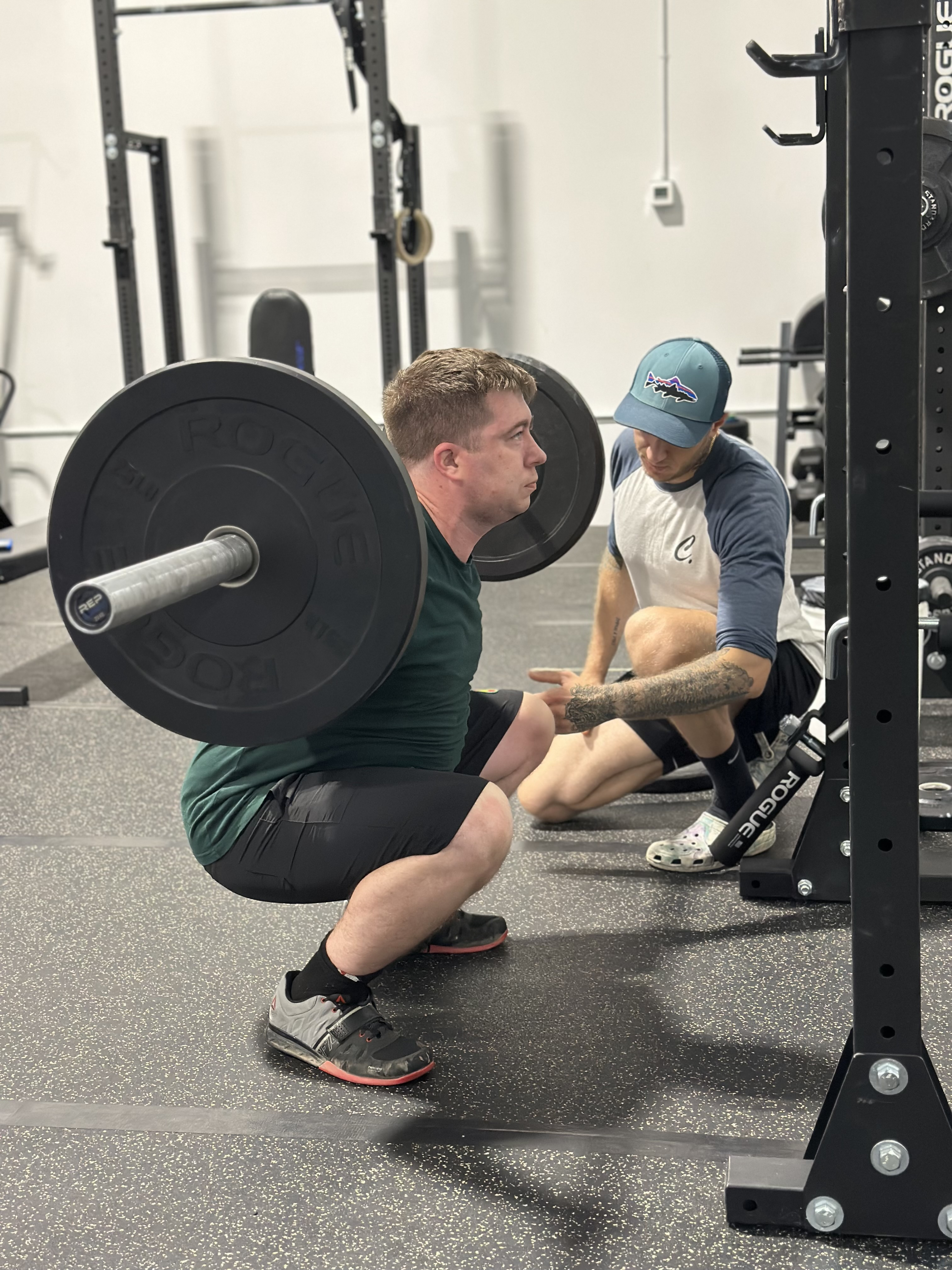
33 Emery Street, Portsmouth. A real barbell gym — platforms, racks, trap bars, dumbbells, kettlebells, rowers and bikes. Not a circuit of machines and not a mirror-lined studio.


Before you call
The things people want to know and usually don't ask.
Parking is available on site at 33 Emery Street — free, off-street, and a short walk to the door. You're not circling downtown Portsmouth looking for a meter.
About an hour, door to door. The first visit runs a little longer because of the sit-down conversation at the start.
Whatever you'd go for a walk in. Flat, firm-soled shoes are better than cushioned running shoes for lifting — but come in what you own, and we'll talk about shoes later if it matters.
Yes — mid-morning is the calmest stretch of the day and it's when most of our 50-plus members train. If you'd rather not share the floor with a crowd, ask for a mid-morning slot and you'll usually have the place nearly to yourself.
Sometimes, and it's less of a problem than you'd think — but if you'd rather not, we'll schedule you into a quiet window. One-on-one sessions are one-on-one regardless of who else is in the building.
No. That's backwards, and it's the single most common reason people put this off for another year. Week one is sit-to-stands and carries. We start where you are.
Water, and anything your doctor or physical therapist has given you in writing — a post-op protocol, a DEXA result, restrictions. If you have it, bring it. If you don't, come anyway.
grizzlywlinfo@gmail.com · (603) 501-9572
Email is the best way in — write as much or as little as you like, including anything your doctor has said, and Stan answers it himself. The phone is there if you would rather talk it through.
Common Questions
No — this is when it matters most. The published research runs into the nineties: nonagenarians in a Tufts study more than doubled their leg strength in eight weeks of supervised high-intensity training. We regularly start lifters in their 60s and 70s who have never touched a barbell.
Yes, with specific constraints, and it's one of the better things you can do for your bones. For established osteoporosis — especially with any history of a vertebral fracture — the rule we work to is no loaded spinal flexion and no loaded rotation, so no crunches, sit-ups, twists, loaded side bends, or rounded-back rowing. Osteopenia is a lower risk and the evidence doesn't demand the same restriction; we still start you inside it because it costs you nothing, but we'll say honestly that it's us erring safe rather than a hard limit. What you do instead is trap-bar and block deadlifts with a braced, neutral back, goblet and box squats, loaded carries, hip thrusts, and overhead or landmine pressing, loaded progressively over months. That's the same pattern as the LIFTMOR trial, which improved spine and femoral neck bone density in postmenopausal women with low bone mass, with one minor adverse event across the whole eight months.
Yes. We work to your surgeon's precautions, find the squat depth where the knee is quiet, and set a box or a pin at that height so you never go past it. Kneeling drills come out entirely and get done standing or seated on a bench. Deadlifts, step-ups, carries, and hip thrusts all stay in. If the knee swells the day after a session, that's our signal that the volume was too high, and we cut it.
The first thing we ask is which surgical approach your surgeon used, because the at-risk position isn't the same for both. A posterior hip is guarded against deep flexion, adduction past the midline, and flexion combined with internal rotation. An anterior hip is guarded against roughly the opposite — extension combined with external rotation. And many surgeons now prescribe no positional precautions at all past the early weeks. If you don't know which approach you had, we'll ask you to check with the surgeon's office and we default conservative until you do. We also ask when the precautions lift, because they're normally time-limited — commonly six to twelve weeks — rather than permanent. Either way the training looks similar: trap-bar deadlifts, box squats to a depth that's comfortable and permitted, hip thrusts, banded abduction, carries, and single-leg balance work, which is usually the most valuable thing we can give a replaced hip.
Then nothing on your program will ask you to. Floor press becomes bench or incline press, dead bugs become standing Pallof presses, glute bridges become hip thrusts off a bench, and stretching happens standing or seated. Separately, we train getting off the floor as its own skill — from a high bench, down to a low box, down to the floor, over months. A lot of members arrive unable to do it and leave able to.
See a physical therapist first, and we mean that. We're strength coaches, not clinicians — we can't diagnose what's causing pain, and training on top of an undiagnosed problem is how small problems get bigger. We'll tell you which Seacoast clinics we'd send our own family to, and we'll take you the week you're cleared.
Sometimes there are competitive lifters on the platforms, and most people find it motivating rather than intimidating. But if you'd rather not, say so — mid-morning is quiet, it's when most of our 50-plus members train, and we'll put you in that window. One-on-one coaching is one-on-one no matter who else is in the room.
You should not be sore after your first session — if you are, we made day one too hard, and we'll say so. Some muscle soreness is normal once you're training regularly and it fades within a few weeks. As for injury: supervised, progressive strength training has a very low injury rate, lower than most recreational sports, and every set you do here is watched by a coach who will stop it when position goes.
Two sessions a week is genuinely enough to hold onto muscle, bone, and balance, and it's where most of our 50-plus members sit. Three is better if your schedule allows it. We'd rather you did two a week for five years than four a week for a month.
It's always wise to check in, and for some conditions we require it in writing — a cardiac condition your doctor is managing, uncontrolled blood pressure or diabetes, a recent stroke, or active cancer treatment. You don't have to explain us to them: we hand you our information sheet for referring clinicians, a single page setting out what we're proposing, what we don't do, and a clearance form your physician can sign. It's published on this site, so you can read it before they do.
An hour, no pressure, no obligation. Sit down with the coach, tell him what your doctor said, and see whether this is the right room for you.
Email us to book your free introPrefer the phone? (603) 501-9572 works too — email just reaches the coach faster.